

Are you Measuring Background or your Sound Level Meters Noise Floor?
Audiometric testing requires environments with very low background noise to avoid two major problems:
- Patient distraction, and
- Masking or corrupting the test signals.
Because human perception of sound is strongly contextual and subjective, clinicians cannot reliably judge an environment’s suitability without objective sound level measurements.
The strictest requirements are for measurements down to 0 dB HL with open ears, whereas screening with enclosed headsets at thresholds above – 30 dB HL allows much more background noise. It’s prudent, however, to start by examining the most demanding case.
Sound Level Meter Requirements and Self-Generated Noise
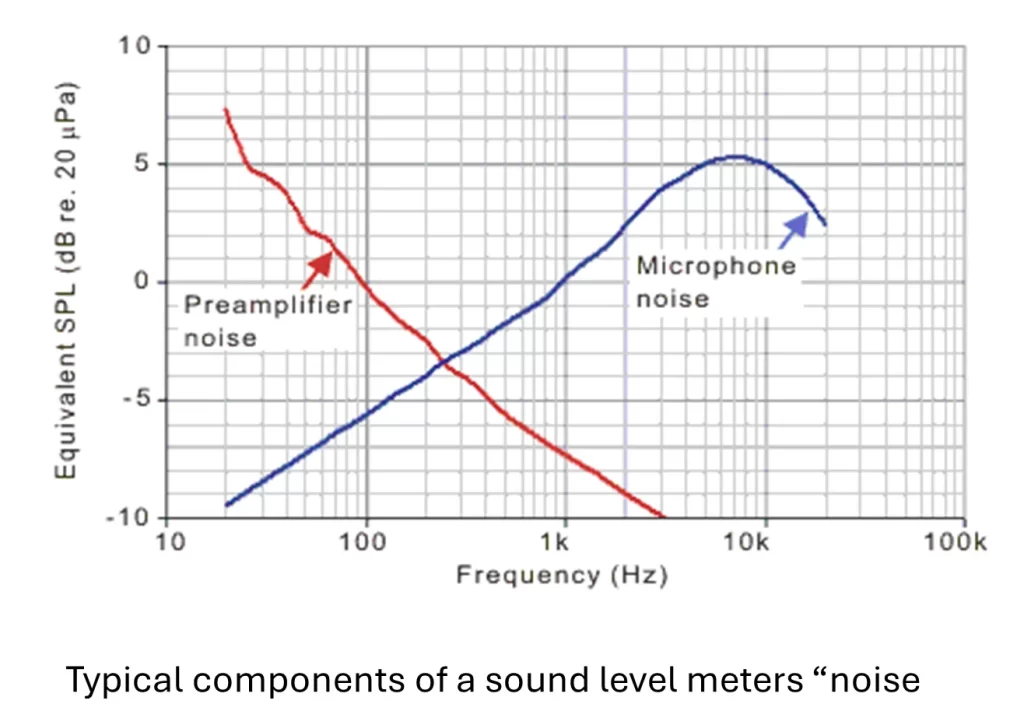
Every sound level meter has a self-generated noise floor that limits the lowest measurable level. It comes from:
- Electrical noise (thermal noise in electronics), typically at low frequencies.
- Acoustic noise (Brownian motion acting on the microphone diaphragm), dominating higher frequencies.
Since noise adds energetically, the error becomes:
- Negligible if background noise is >20 dB above the noise floor
- +0.4 dB error when the difference is 10 dB
- +3 dB error when the background is equal to the noise floor
Thus, the meter’s noise floor should be at least 10 dB below the lowest background noise level you need to verify.
Calibration and Interpretation
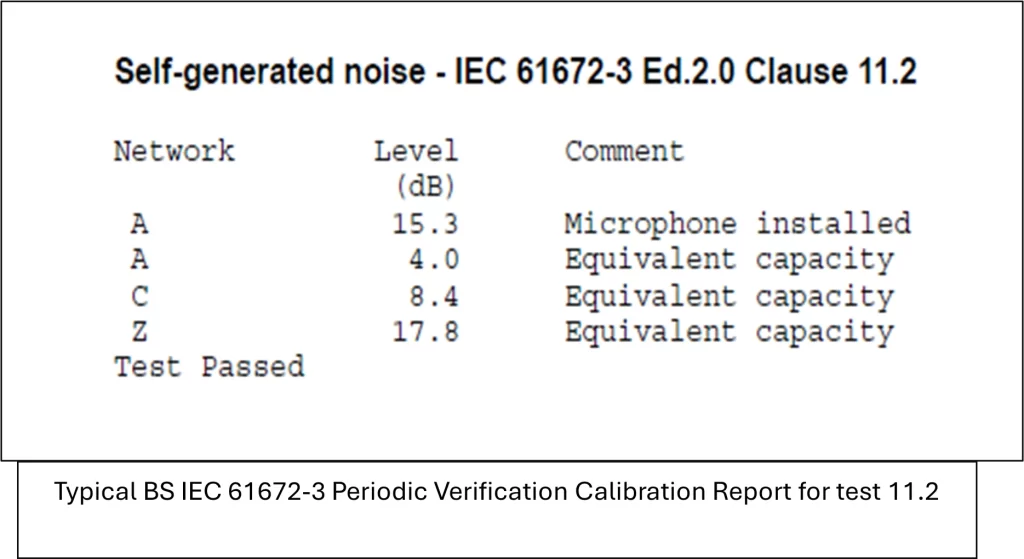
Accredited calibration reports normally show two self-noise measurements:
1. Complete instrument with microphone attached (dB(A))
This includes both electromagnetic and acoustic self-noise plus unknown residual noise in the “quiet” calibration room.
2. Electrical self-noise using a dummy microphone
Reported for A-, C-, and Z-weightings, allowing assessment of frequency-dependent behaviour.
Typically:
- A-weighted noise is lowest, because A-weighting attenuates low frequencies
- Z or C-weighted values are higher, because electrical noise is mainly low-frequency
Calibration standards do not impose pass/fail criteria for self-noise; they only require reporting. Meters naturally get noisier with age and environmental stress. The technician must therefore:
- Know the instrument’s noise floor
- Understand that the calibration figure includes ambient noise from the test room
- Recognise that the real noise floor may be higher than the reported one
Audiology-Specific Requirements: Third-Octave Bands
Standard calibration reports use broadband frequency weightings, but audiology requires third-octave band criteria, as specified in:
- BS 8253-2:2009, and
- BSA Guidance
Therefore:
- A third-octave band SLM is essential, and
- Self-generated noise values must also be given per third-octave band and calibrated to verify compliance.
Enhanced calibration services can measure and report the SLM’s true third-octave noise floor, enabling direct comparison with audiometric room criteria. Typical results shown below:
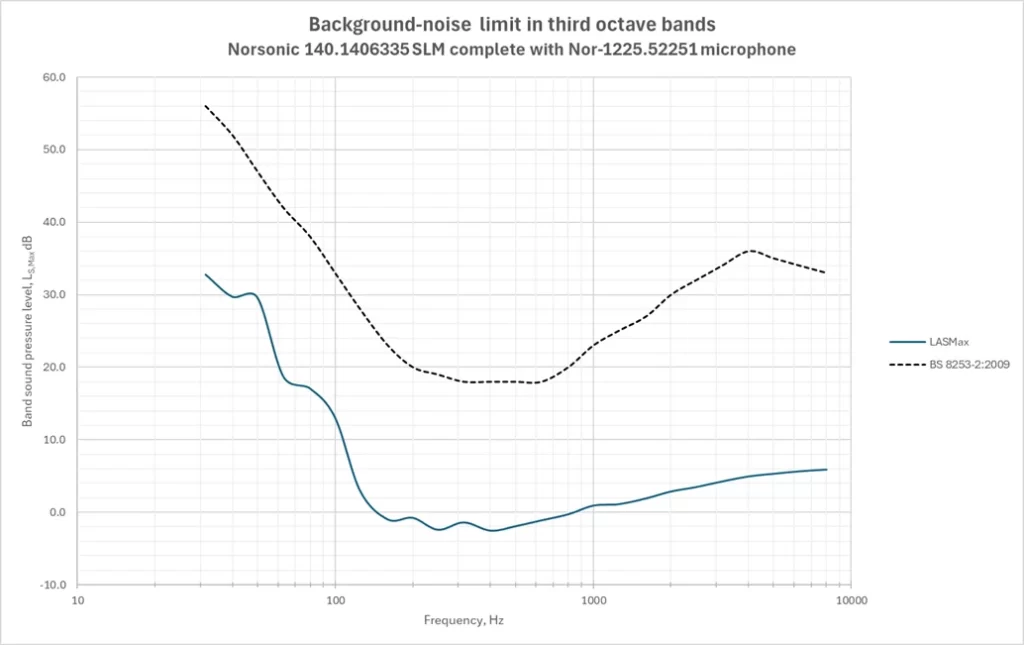
Recommended background noise level for 0 dB HL audiometry and the verified LASmax of a reference class 1 sound level meter showing the -10 dB signal to noise can easily be obtained.
Campbell Associates supply sound level meters and audiometer calibration hardware, software and have an independent UKAS accredited calibration laboratory (0789) for acoustic and audiometer test equipment.


