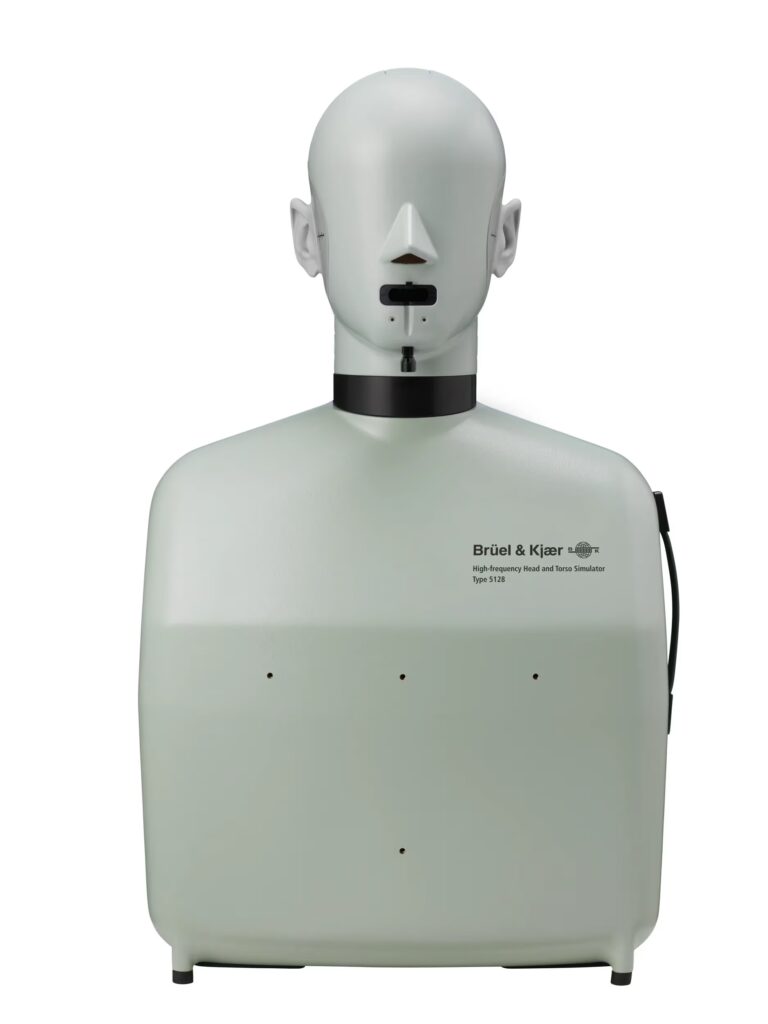
In industries where audio quality and acoustic accuracy can define a product’s success, the Head and Torso Simulator (HATS) is an indispensable tool. By replicating the acoustic properties of an average human head and torso, these manikins allow engineers to gather realistic data for telecommunications, automotive design, audiometry, and advanced research.
However, a HATS system is only as reliable as its calibration. Because these instruments are used in precision applications where measurement integrity is essential, understanding how they are calibrated is just as important as the calibration itself.
Component vs. Full-System Calibration
Traditionally, calibrating an acoustic manikin often meant disassembling the unit. Technicians would remove the individual ear simulators, microphones, and preamplifiers to test them independently in a laboratory setting.
While component calibration ensures that each separate part meets its specific tolerances, it introduces a critical blind spot: it fails to account for how the components interact as a unified system.
When a HATS is used in the field, sound waves interact with the physical structure of the head, the pinnae of the ears, and the contours of the torso. This interaction alters the acoustic response, a phenomenon known as the head-related transfer function (HRTF). Disassembly bypasses these geometric and acoustic influences.
The Free-Field Advantage
To capture the true performance of a HATS, it must be calibrated exactly as it is intended to be used: as a complete, fully assembled unit. This is achieved through free-field calibration.

Free-field calibration takes place inside an anechoic room, a specialised environment designed to completely absorb sound reflections and isolate the equipment from external noise.
- The Process: The complete HATS system is placed in the anechoic chamber. Controlled acoustic signals are generated from precise angles, allowing technicians to measure the response of the entire system simultaneously.
- The Benefit: This method accounts for the acoustic reflections, diffractions, and shielding caused by the physical shape of the manikin itself. It ensures that the microphones inside the ears are recording exactly what they would experience in a real-world testing scenario.
By choosing full-system free-field calibration over component breakdown, labs eliminate the risk of reassembly errors and gain a much higher level of confidence in their day-to-day measurement integrity.
Supported Industry Standards
At Campbell Associates, we provide UKAS-accredited free-field calibration for complete HATS systems within our custom-built anechoic room. Our facility is equipped to handle the industry’s most widely used precision acoustic manikins, ensuring your hardware remains compliant with international standards.
We regularly calibrate market-leading models, including:
- Brüel & Kjær: Model 4128 Head and Torso Simulator
- GRAS: KEMAR 45BB and 45BC Acoustic Manikins
Maintaining the accuracy of your simulator shouldn’t require compromising its structural integrity. By utilising full-system testing, you ensure that your data remains seamless, traceable, and perfectly reflective of human hearing.