February 2026 | Campbell Associates

Mastering Section 61: The ultimate guide to environmental monitoring and compliance

News

For construction and demolition firms in the UK, navigating the Control of Pollution Act 1974 is a critical component of project delivery. Specifically, securing a Section 61 consent is the gold standard for proactive site management. It not only protects your project from the risk of a Section 60 stop-work notice but also demonstrates your commitment to Best Practicable Means (BPM) in mitigating noise, vibration, and dust.

At Campbell Associates, we provide more than just equipment; we provide a full-spectrum partnership to guide you through the Section 61 application process, from baseline surveys to automated compliance reporting.

What is a Section 61 Application and Why is it Essential?

A Section 61 application is a formal request for “prior consent” from a Local Authority regarding the noise and vibration impact of your planned works. By securing this agreement before you break ground, you achieve:

  • Legal Protection: Compliance with a Section 61 agreement prevents the council from serving a Section 80 abatement notice or a Section 60 notice, which can impose strict working hours or halt production.
  • Community Trust: Providing a clear Dust Management Plan (DMP) and noise mitigation strategy reduces community complaints and enhances your brand reputation.
  • Operational Certainty: You establish agreed-upon threshold limits and working hours, allowing for accurate project scheduling and budgeting.

How Campbell Associates Supports Your Section 61 Journey

We help you meet the rigorous requirements of BS 5228 (Noise and Vibration Control on Construction and Open Sites) and IAQM (Institute of Air Quality Management) guidance through a three-stage approach:

1. Pre-Construction: Baseline Surveys and Prediction

Before work begins, you must establish the existing “ambient” levels of the area. We provide Class 1 Sound Level Meters and Vibration Monitors to conduct accurate baseline surveys.

  • Acoustic Prediction: We offer CadnaA noise prediction software to help you model the impact of your plant and machinery, a vital part of your Section 61 submission.

2. Construction Phase: Real-Time Monitoring & NVD Strategy

Once the project is live, our NVD (Noise, Vibration, and Dust) monitors provide the 24/7 data required to prove you are working within your agreed limits.

  • Noise Monitoring: Our NoiseSens and SiteSens systems offer remote access and audio triggers to identify the source of any noise breach.
  • Vibration Monitoring: Using the Syscom Rock we measure Peak Particle Velocity (PPV) to protect sensitive structures and satisfy BS 7385-2 requirements.
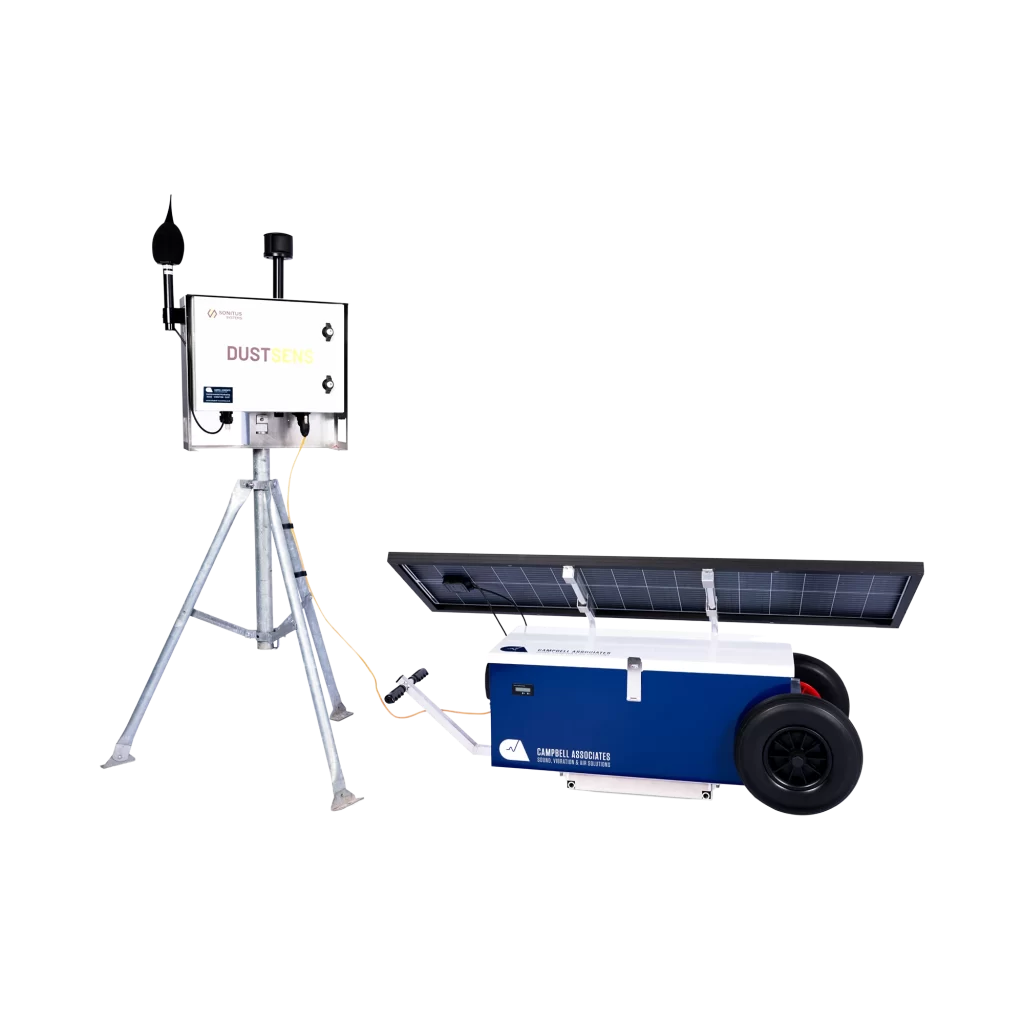
  • Dust Monitoring: Our DustSens systems are MCERTS certified, utilising heated inlets to ensure accurate PM10 and PM2.5 readings, even in the UK’s high humidity.

3. Compliance & Reporting: The Sonitus Cloud

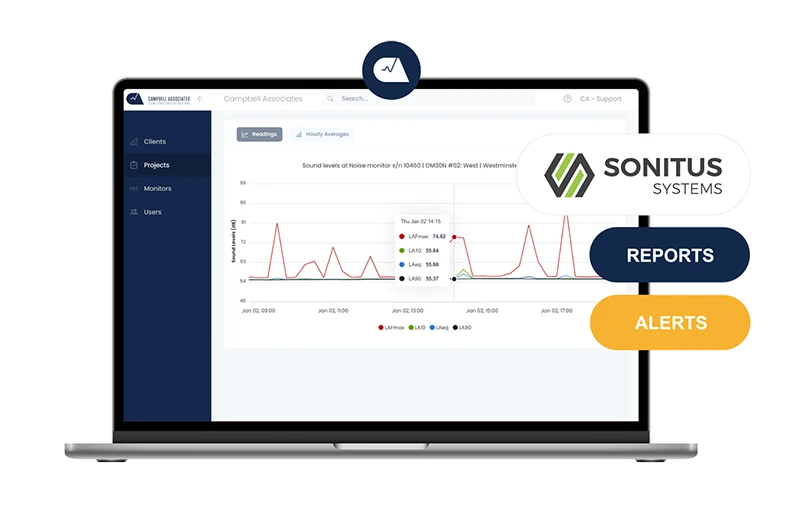
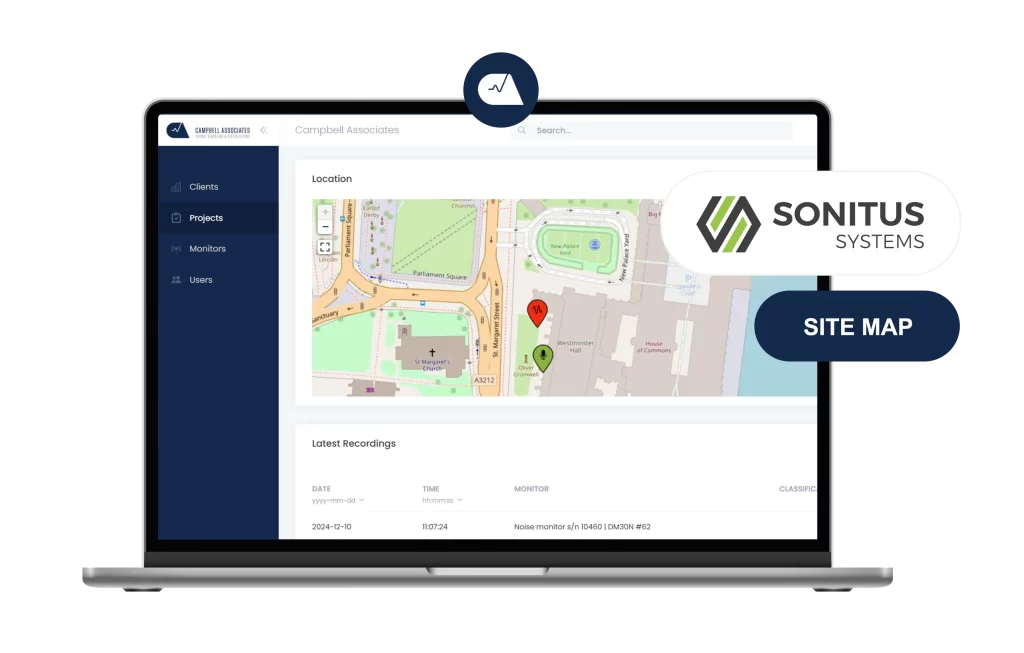
The key to a successful Section 61 is the audit trail. All Campbell Associates monitors feed data into the Sonitus Cloud, a centralised portal that:

  • Automates Reporting: Generate weekly or monthly compliance reports to send directly to Environmental Health Officers (EHOs).
  • Instant Alerts: Receive SMS and email notifications the moment a threshold is approached, allowing for immediate on-site mitigation.
Optimising Your Site with Integrated Environmental Monitoring

Monitoring TypePrimary Regulation/StandardEquipment Solution
NoiseCoPA 1974 / BS 5228-1SiteSens / NoiseSens
VibrationBS 5228-2 / BS 7385-2Syscom Rock / AvaTrace
Dust (Air Quality)Environment Act / IAQMDustSens (MCERTS)

Don’t Risk Your Project’s Timeline

A failed Section 61 submission or a single noise complaint can cost thousands in delays. By partnering with Campbell Associates, you ensure your site is equipped with the UK’s most reliable, MCERTS-certified and Class 1 monitoring technology.

Would you like our team to review your upcoming project requirements and recommend a bespoke monitoring package for your Section 61 application?

Why heated inlets are important for dust monitors on UK construction sites

Air Quality & Dust

The Importance of Dust Monitoring in the UK

Dust monitoring is a mandatory component of construction site management in the UK, governed primarily by the Control of Substances Hazardous to Health (COSHH) Regulations 2002 and the Environmental Protection Act 1990. Construction activities such as demolition, excavation, and cutting release significant amounts of airborne dust; including Respirable Crystalline Silica (RCS) and particulate matter like PM10 and PM2.5. These pose severe health risks and can trigger “statutory nuisance” claims under Section 79 of the Environmental Protection Act.

To maintain compliance with HSE Workplace Exposure Limits (WELs) and IAQM (Institute of Air Quality Management) guidance, real-time monitoring is essential. It allows site managers to protect worker health, satisfy local authority planning conditions (Section 106 agreements), and provide a robust data audit trail to defend against community complaints.

Humidity vs. Accuracy

In the unpredictable climate of the UK, the core issue for monitoring is humidity. Dust particles are often hygroscopic, meaning they attract water. In the UK, where relative humidity often exceeds 80%, this becomes a major technical hurdle for site managers.

What Is a Heated Inlet?

A heated inlet is a sample conditioning component fitted where outside air enters a dust monitor. It slightly warms the incoming air before it reaches the internal sensors or sampling chamber. While heating air in environmental instruments might seem counterintuitive, the benefits for dust monitoring are significant: it evaporates the water attached to the dust, ensuring you measure the dry mass of the particles rather than the water content.

Heated vs. Non-Heated Inlets

FeatureNon-Heated InletHeated Inlet (Smart Heated)
How it WorksPulls ambient air directly into the sensor.Warms the air (35–50°C) before it hits the sensor.
AccuracyProne to “over-reading” by up to 50% in damp conditions.Evaporates moisture so only the dry mass is measured.
Power NeedsVery low (often runs on small solar panels).Higher (requires mains or large battery arrays).
UK RegulationRarely meets MCERTS standards for official reporting.Often required for Section 106 or high-risk sites.
Best Use CaseShort-term, internal, or “indicative” low-budget checks.Perimeter monitoring for legal and planning scrutiny.

Why the UK Specifically Requires Heated Inlets

If your construction site is in a large city, or any coastal area, humidity is your biggest enemy. Using a non-heated inlet often leads to phantom dust spikes in your data that occur around 6:00 AM when the dew point is reached, but before any machinery has started.

  1. MCERTS Compliance: The Environment Agency’s MCERTS standard for UK dust monitoring often requires equivalence to the reference method. Non-heated monitors struggle to achieve this because they don’t manage moisture, making their data legally questionable, if you are trying to defend against a local council’s abatement notice.
  2. Avoiding Stop Work Orders: If your site uses automated alerts, a non-heated monitor might send a high dust text to the site manager during a rainy afternoon. If you stop work based on that data, you’re losing money for no reason. Conversely, if you don’t stop work, you have a record of a breach that didn’t actually happen.

The Rule of Thumb: If the data is being sent to a Local Authority or used for legal compliance in the UK, always go for a heated inlet.

The Campbell Associates Solution

The Campbell Associates range of environmental monitors including the AQS-1, DustSens, and SiteSens features advanced heated inlet technology as a standard. In the volatile UK climate, where high humidity and morning mist are common, these systems prevent the mistaking of water vapor for dust. By warming the incoming air to a constant temperature before it reaches the optical sensor, Campbell Associates’ systems ensure that the data used for MCERTS reporting and planning condition compliance is both accurate and legally defensible, preventing unnecessary project stoppages caused by phantom dust spikes.

Off-Grid Environmental Monitoring: Powering Compliance through Solar and Battery Innovation

Construction Resources

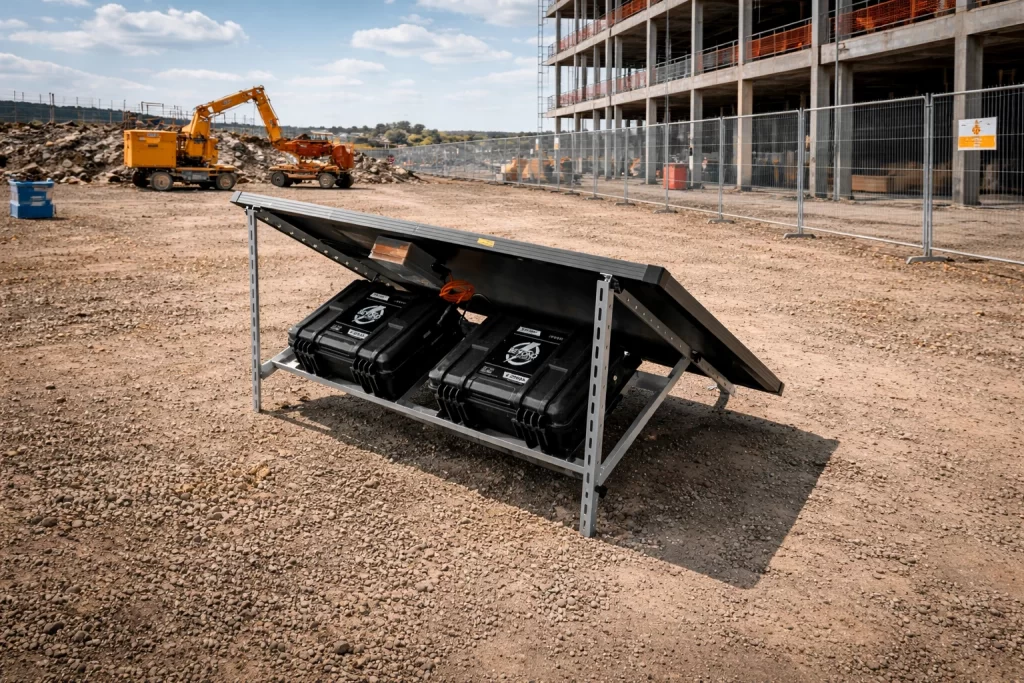
From meeting your sustainability and Net Zero targets to simply having no mains power, there are multiple reasons why UK construction and demolition sites require off-grid power. Off-grid renewable energy systems, specifically solar-plus-storage solutions offer a robust method for powering noise, vibration, and dust monitoring equipment. To maintain compliance with Section 61 requirements, sites must ensure an uninterrupted power supply to facilitate continuous, reliable environmental data collection.

Overcoming the UK Climate

While solar power is the gold standard for sustainability, the British weather is famously temperamental. For construction sites, intermittent power is not an option; a gap in data can lead to a breach of Section 61 consent and potential site shutdowns. At Campbell Associates, our philosophy is centred on Solar-Plus-Storage. By pairing high-efficiency panels with high-capacity, intelligent battery systems, we enable sites to bridge the gap between sunny spells and the inevitable grey weeks of a UK winter.

The OGRE PS300: High-Capacity Power for Demanding Sites

For projects requiring maximum autonomy, the OGRE PS300 (Off-Grid Renewable Energy) system stands as the powerhouse of our range. Engineered specifically to handle the higher energy demands of dust monitors and multi-unit setups, the PS300 features a high-output 300W solar array paired with a substantial 2kWh LiFePO4 battery. This combination provides a massive energy reserve, ensuring your monitoring remains live even during the darkest months. Housed in a rugged, powder-coated steel enclosure, the unit is built for the harshest site conditions. It also features our signature security-focused design: a detachable wheel and handle system that allows for easy deployment, which can then be removed to create a tamper-proof, static installation.

Intelligent Battery Technology

To meet rigorous site demands, our solutions, including the Solar Power Hub, are engineered specifically for the continuous, low-wattage draw of environmental monitors like the NoiseSens and VibrationSens units. Key features include:

  • LiFePO4 Technology: We utilise Lithium Iron Phosphate (LiFePO4) for its superior stability and longevity. These batteries thrive in fluctuating UK temperatures (from -20°C to +60°C) without losing efficiency.
  • Bi-Facial Solar Panels: To capture every drop of energy on overcast days, our bi-facial panels collect sunlight from both sides—including light reflected off the ground.
  • Smart Monitoring: Our systems include Bluetooth-enabled controllers, allowing site managers to monitor power levels in real-time via an app.

Seamless Compliance with the Sonitus Cloud

Power is only half the battle; the data is the prize. All our power solutions are designed to work hand-in-hand with our automated monitoring range. When powered by our off-grid systems, monitors report 24/7 to the Sonitus Cloud.

This ecosystem ensures that even on the most remote demolition site, you have a live view of your environmental impact. You get the data you need for compliance, the peace of mind that your equipment will not fail overnight, and the satisfaction of significantly reducing your site’s carbon footprint by removing the need for noisy, high-emission diesel generators.

Conclusion

Transitioning to off-grid solar and battery power is no longer just a green luxury, it is a logistical necessity for modern UK construction. By utilising Campbell Associates’ robust battery solutions, contractors can ensure that their commitment to the environment matches their commitment to project timelines and regulatory excellence.

UKAS calibration for SITMA members

News

In the competitive landscape of sound insulation testing and environmental noise measurement, the precision of your data is your most valuable asset. For members of the Sound Insulation Testing and Measurement Association (SITMA), this precision is non-negotiable. SITMA requires that all noise measurement equipment, including sound level meters, acoustic calibrators, and tapping machines, undergo regular UKAS calibration.

This mandate isn’t just about red tape; it’s a strategic move to ensure Approved Document E compliance and to maintain the highest levels of technical competence in the UK construction industry.

UKAS vs. Traceable Calibration

A common question among acoustic consultants is whether traceable calibration is sufficient. For SITMA members, the answer is a firm no. While traceable calibration offers a documented path to national standards, it often lacks the rigorous, independent auditing that defines an ISO 17025 accredited laboratory.

  • UKAS-Accredited Calibration: The laboratory itself is audited by the United Kingdom Accreditation Service (UKAS) to ensure that every measurement, environmental variable, and staff member meets stringent international standards.
  • Traceable/Verified Calibration: Often provided by manufacturers, this confirms a device is in spec but does not offer the same level of legal defensibility or independent verification of measurement uncertainty.

SITMA Policy PUS007 explicitly states that only UKAS (or ILAC equivalent) certificates are acceptable. This ensures that when a consultant uploads raw data to the SITMA Portal, the foundation of that data, the hardware is mathematically beyond reproach.

Technical Precision and Measurement Uncertainty

Acoustics is a science of the invisible, where tiny fluctuations in air pressure translate into significant data points. Sound level meter calibration at a UKAS lab involves testing the device across its entire frequency range and ensuring the Class 1 or Class 2 accuracy remains intact.

  1. Annual Calibrator Checks: SITMA requires acoustic calibrators to be serviced every year. Since the calibrator is the reference point for every field test, its accuracy is paramount.
  2. Biennial Meter Service: Sound level meters must be calibrated every two years to account for electronic drift and microphone sensitivity changes.
  3. Uncertainty Budgets: Only a UKAS lab provides a detailed uncertainty budget, allowing the consultant to understand the exact margin of error in their field measurements.

Driving Quality in Acoustic Consultancy

Ultimately, SITMA’s insistence on UKAS calibration for acoustic equipment raises the bar for the entire industry. It filters out low-cost operators who might use unverified gear, ensuring that clients receive accurate sound insulation testing that actually reflects the building’s performance. For the professional acoustic consultant, choosing an ISO 17025 lab is an investment in their reputation and a safeguard against the high costs of measurement error.

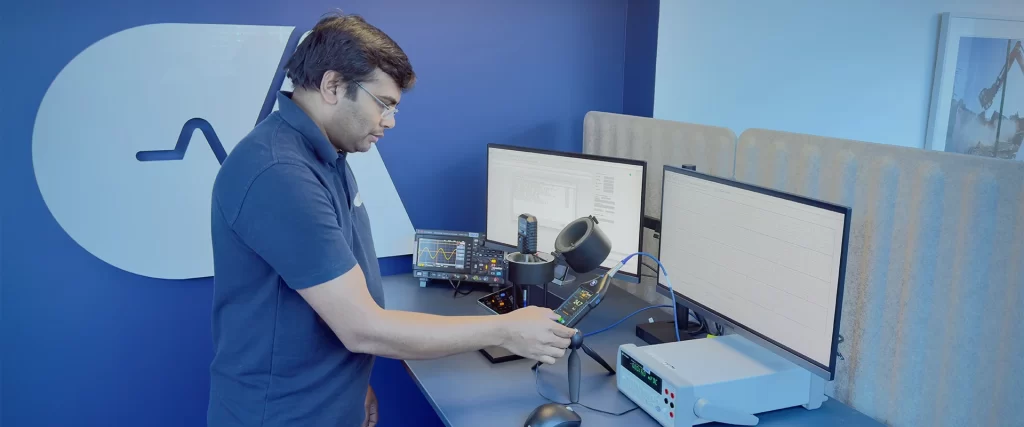
At Campbell Associates, we understand that for a UK acoustic consultant, your data is only as good as the calibration behind it. That’s why we’ve built our UKAS-accredited laboratory (0789) to be the ultimate one-stop shop for your equipment. Whether you’re sending in sound level meters, calibrators, or vibration monitors, our highly experienced team of engineers brings decades of technical expertise to every piece of kit that crosses our bench. We don’t just process equipment; we ensure it’s performing at its absolute peak, giving you total confidence in your measurements.

To make your workflow even smoother, we provide a dedicated online calibration portal that gives you 24/7 access to your entire calibration history. You can instantly view, download, or share your certificates whenever you need them, eliminating the last-minute stress of hunting for paperwork before a site visit or a deadline. By combining rigorous engineering excellence with modern digital convenience, we ensure your instrumentation is always compliant and your business stays moving.

Our SITMA specific building acoustics package addresses your requirements, encompassing UKAS calibration, a onetime precision measurement of a tapping machine, and the evaluation of directivity and stability for measurement speakers.